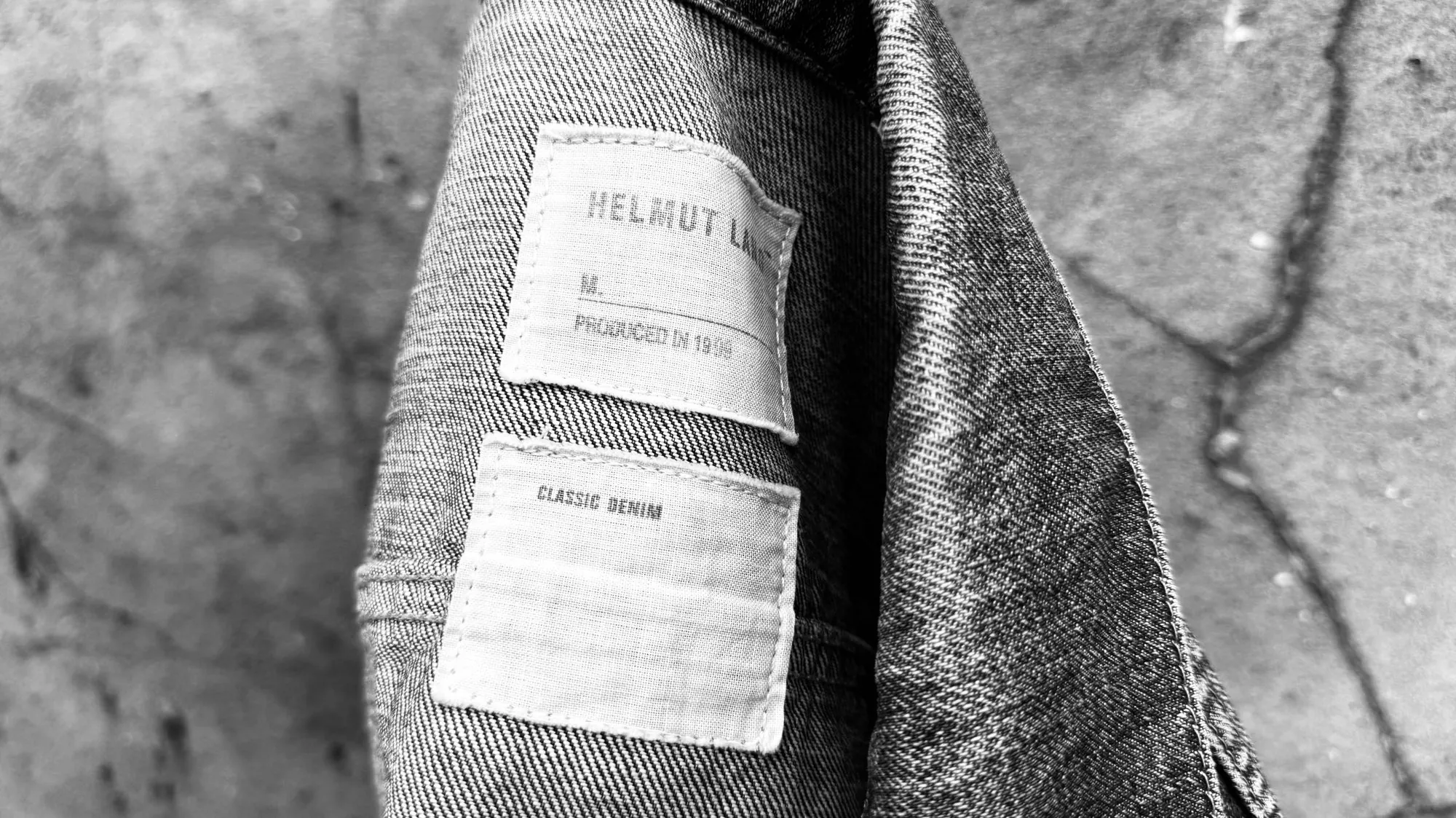
A Levi’s-style trucker jacket from Helmut Lang’s Classic Denim line, made in the year Prada took control of the company, when Lang still ran every part of it from New York.
Inside the yoke of this jacket, a small label reads “Produced in 1999”. It is the kind of label Helmut Lang put in his denim: a size, a year of production and the name of the line, Classic Denim. There was no season and no campaign name, only the date the garment was made. For a designer who treated clothes as objects rather than as images, the label said what mattered.
Helmut Lang Jeans
Lang announced Helmut Lang Jeans in July 1996, with a wraparound on the International Herald Tribune that showed no product at all: a cropped portrait by Elfie Semotan, the name and a few lines saying the collection would launch for summer 1997. The new line covered khakis, chinos, denim, workwear, casual and protective clothing. It drew on the American workwear Lang had studied for years, the canonical jeans and jackets that every brand had copied.
At first the line was produced under licence, by the Italian manufacturer GTR Group, and distributed in the United States by Onward Kashiyama. Yet the denim was cut with the same attention as the tailoring, priced well above ordinary jeans and sold alongside the main collection. That position, between the mainline and a mass product, is why Helmut Lang Jeans is widely considered one of the starting points of designer denim.
The jacket
The Classic Denim trucker jacket takes as its reference the Levi’s Type III, the jacket with pointed chest pockets and V-shaped seams introduced in the 1960s and reproduced by almost every denim brand since. Lang did not redesign it. He reduced it to proportion and construction: a shorter, narrower body, a cleaner line through the shoulders and the yoke. The changes are quiet and only read up close. The topstitching is in contrasting orange, and the silver buttons are engraved with his name. Nothing else announces the designer.
The same year he introduced the line, Lang also released the denim that made it famous. The Painter Jeans, first shown in 1997 for Spring/Summer 1998, carried screen-printed splashes that imitated a decorator’s paint. In 1999 Alexander McQueen was photographed in his own pair, a sign of how far the jeans had travelled among other designers.
New York
By then Lang had moved his company from Vienna to New York, one of the first European houses to do so. In April 1998, instead of holding his first New York show, he presented Autumn/Winter 1998–99 online: a fifteen-minute video and photographs of 81 looks on his website, with a CD-ROM sent to selected editors and buyers. It was the first fashion collection ever presented over the internet. In the same year his name appeared on more than a thousand New York taxi roofs, pointing to the new site.
“The label said what mattered: the date the garment was made.”
1999
In 1999, with annual sales of around €100 million, the Prada Group bought 51% of the company. Prada took over production and distribution; Lang kept control of design and advertising. In the years that followed, the separate product lines were consolidated under the main Helmut Lang label.
This jacket comes from that moment, the New York years in which Lang still directed every aspect of the house. In 2004 Prada bought the rest of the company, and in 2005 Lang left fashion.
After fashion
Lang has since worked only as an artist. In 2009 and 2010 he donated pieces from his fashion career to museums around the world, among them the Fashion Museum in Bath. In 2011 the contents of the Helmut Lang Archive, more than ten thousand objects, went to the MAK in Vienna, which presented them in December 2025 in the exhibition “Helmut Lang. Séance de Travail 1986–2005”. Denim from the line is now kept in museum collections next to the runway pieces, and labels like this one, with the year of production, help date it.
Una trucker jacket in stile Levi’s della linea Classic Denim di Helmut Lang, prodotta nell’anno in cui Prada ha preso il controllo dell’azienda, quando Lang la dirigeva ancora in ogni aspetto da New York.
Dentro lo sprone di questa giacca, una piccola etichetta riporta “Produced in 1999”. È il tipo di etichetta che Helmut Lang metteva nel suo denim: una taglia, un anno di produzione e il nome della linea, Classic Denim. Non c’erano stagione né nome di campagna, solo la data in cui il capo era stato fatto. Per un designer che trattava gli abiti come oggetti più che come immagini, l’etichetta diceva l’essenziale.
Helmut Lang Jeans
Lang ha annunciato Helmut Lang Jeans nel luglio 1996, con una sovracoperta dell’International Herald Tribune che non mostrava alcun prodotto: un ritratto tagliato di Elfie Semotan, il nome e poche righe che dicevano che la collezione sarebbe stata lanciata per l’estate 1997. La nuova linea comprendeva khaki, chino, denim, abbigliamento da lavoro, casual e protettivo. Partiva dall’abbigliamento da lavoro americano che Lang studiava da anni, i jeans e le giacche canonici che tutti i marchi avevano copiato.
All’inizio la linea era prodotta su licenza dall’azienda italiana GTR Group e distribuita negli Stati Uniti da Onward Kashiyama. Eppure il denim era tagliato con la stessa attenzione della sartoria, con prezzi ben sopra quelli dei jeans comuni, e venduto accanto alla collezione principale. Questa posizione, a metà tra la linea principale e un prodotto di massa, è il motivo per cui Helmut Lang Jeans è considerato uno dei punti di partenza del denim di lusso.
La giacca
La trucker jacket della linea Classic Denim prende come riferimento la Levi’s Type III, la giacca con i taschini a punta e le cuciture a V introdotta negli anni Sessanta e riprodotta da quasi tutti i marchi di denim da allora. Lang non l’ha ridisegnata. L’ha ridotta a proporzione e costruzione: corpo più corto e più stretto, una linea più pulita sulle spalle e sullo sprone. Le differenze sono silenziose e si leggono solo da vicino. Le impunture sono arancioni a contrasto e i bottoni argentati sono incisi con il suo nome. Nient’altro rivela il designer.
Nello stesso periodo Lang ha presentato anche il denim che ha reso famosa la linea. I Painter Jeans, usciti per la prima volta nel 1997 per la Primavera/Estate 1998, avevano schizzi serigrafati che imitavano la vernice di un imbianchino. Nel 1999 Alexander McQueen è stato fotografato con il suo paio, segno di quanto quei jeans circolassero anche tra gli altri designer.
New York
A quel punto Lang aveva trasferito l’azienda da Vienna a New York, tra le prime maison europee a farlo. Nell’aprile 1998, invece di tenere la sua prima sfilata newyorkese, ha presentato l’Autunno/Inverno 1998–99 online: un video di quindici minuti e le fotografie di 81 look sul suo sito, con un CD-ROM inviato a giornalisti e buyer selezionati. È stata la prima collezione di moda mai presentata su internet. Nello stesso anno il suo nome è comparso sui tetti di oltre mille taxi di New York, rimandando al nuovo sito.
“L’etichetta diceva l’essenziale: la data in cui il capo era stato fatto.”
1999
Nel 1999, con un fatturato annuo di circa 100 milioni di euro, il Gruppo Prada ha acquisito il 51% della società. Prada ha preso in mano produzione e distribuzione; Lang ha mantenuto il controllo del design e della pubblicità. Negli anni successivi le linee di prodotto separate sono state riunite sotto il marchio principale Helmut Lang.
Questa giacca viene da quel momento, gli anni di New York in cui Lang dirigeva ancora ogni aspetto della maison. Nel 2004 Prada ha rilevato il resto della società, e nel 2005 Lang ha lasciato la moda.
Dopo la moda
Da allora Lang lavora solo come artista. Nel 2009 e nel 2010 ha donato capi della sua carriera nella moda a musei di tutto il mondo, tra cui il Fashion Museum di Bath. Nel 2011 il contenuto dell’Helmut Lang Archive, oltre diecimila oggetti, è passato al MAK di Vienna, che lo ha presentato nel dicembre 2025 nella mostra “Helmut Lang. Séance de Travail 1986–2005”. Il denim della linea è oggi conservato nelle collezioni museali accanto ai capi di sfilata, e etichette come questa, con l’anno di produzione, aiutano a datarlo.