Four characters at the margins of society, and an invisible force that shapes them: Laura Enrico’s graduate collection is about the people we choose not to see.
Laura Enrico designed ‘As the wind touches’ as a fashion design student at NABA in Milan. It is born from the fragile threshold between the visible and the invisible, from the oscillation between presence and marginality. It explores lives that exist and yet are ignored: the homeless, the orphan, the prostitute and the former prisoner. Precarious, unstable figures searching for safety, belonging and meaning in a world that often turns its back on them. Their lives are fragile and mutable, their bodies bent under weight and deformed by time and by the invisible pressures that run through them.
The project takes shape through what she calls “The Shape of the Wind”. The wind is invisible yet constant: it shapes rocks, bends trees and carves the landscape. In the same way, social pressure, imposed ideals and dominant cultural models silently mould and erode human lives. Those who exist at the margins of society, without a recognised role, are shaped even more drastically by this external gaze. “The forces of nature thus become a living metaphor for the dynamics that stir society,” she writes.
Bodies under weight
The research began with images of human bodies, clothed and naked, marked by bumps, distortions and contortions. Bodies bent under heavy loads and deformed by effort and by the passage of time, belonging to humble, authentic figures. In her notes she wrote of bodies deformed by shame, work and social pressure, and of a physicality that is imperfect, but resistant and alive.
The volumes of the collection come from there, not from an aesthetic ideal. They grow out of the bodies themselves, from the burdens they carry and the deformations they bear. They bend, swell and twist, and the garments become mutable organisms, extensions of the body and of its experience.
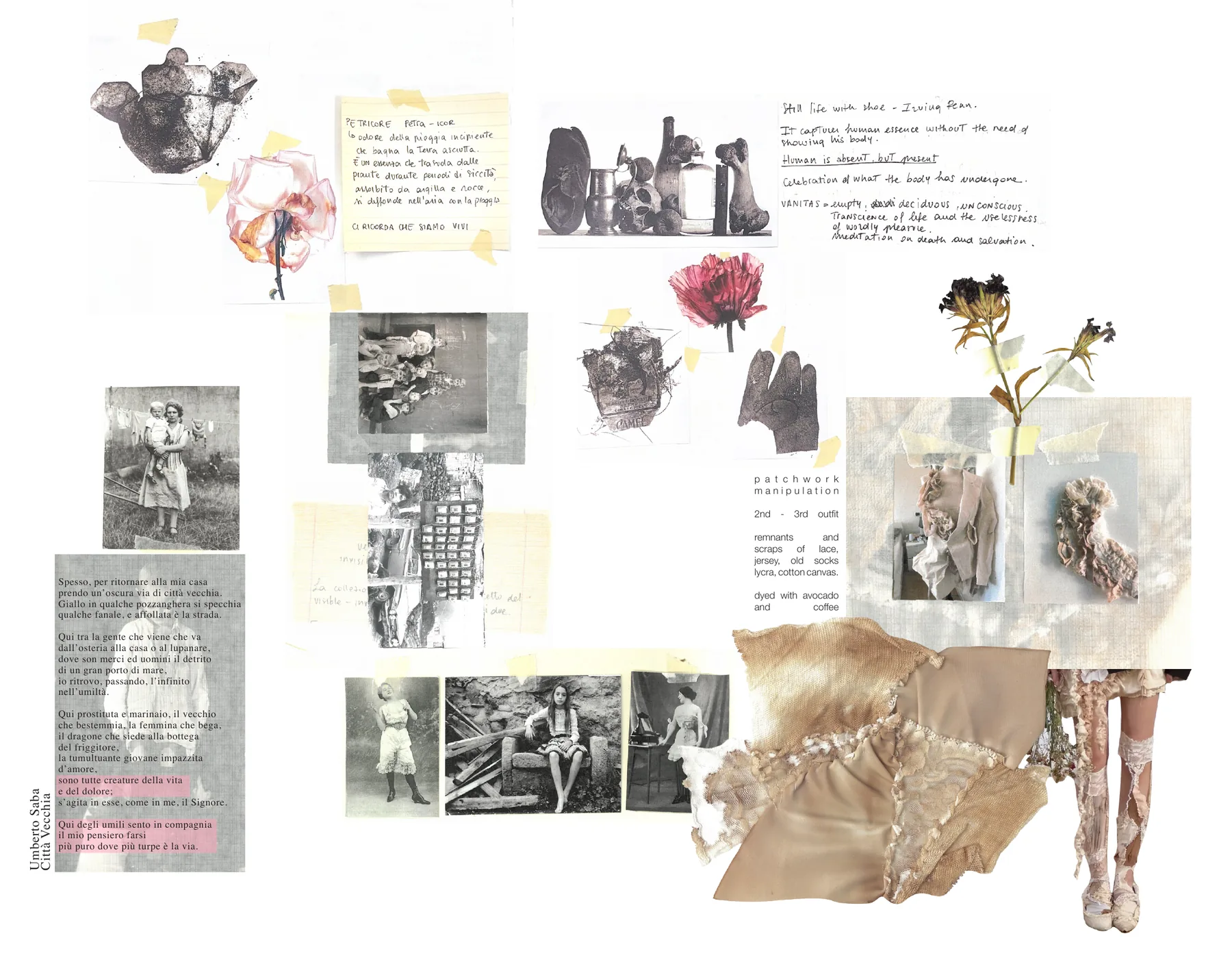
Her sketchbook also gathers August Sander’s portraits of social types, read as an ethical study of real people inside real social structures: everyday clothes, postures shaped by labour and habit, faces marked by work and fatigue. Next to them are Irving Penn’s still lifes of worn shoes, where the human figure is absent but present, and two Italian texts: Umberto Saba’s poem “Città vecchia”, which finds the prostitute and the sailor among the crowd of an old port town, and Fabrizio De André’s “La canzone di Marinella”, where it is the wind that carries the girl away.
Four characters
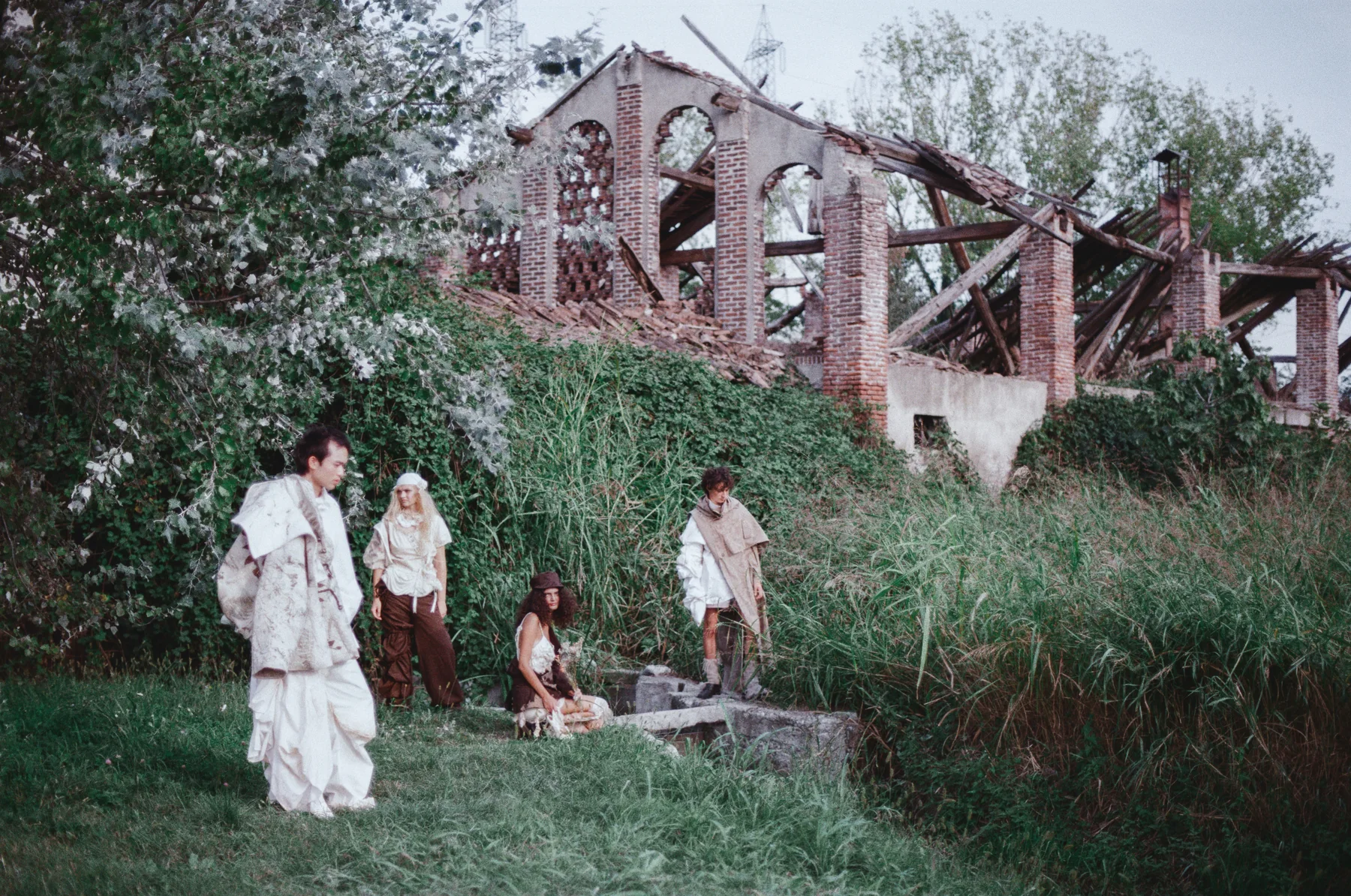
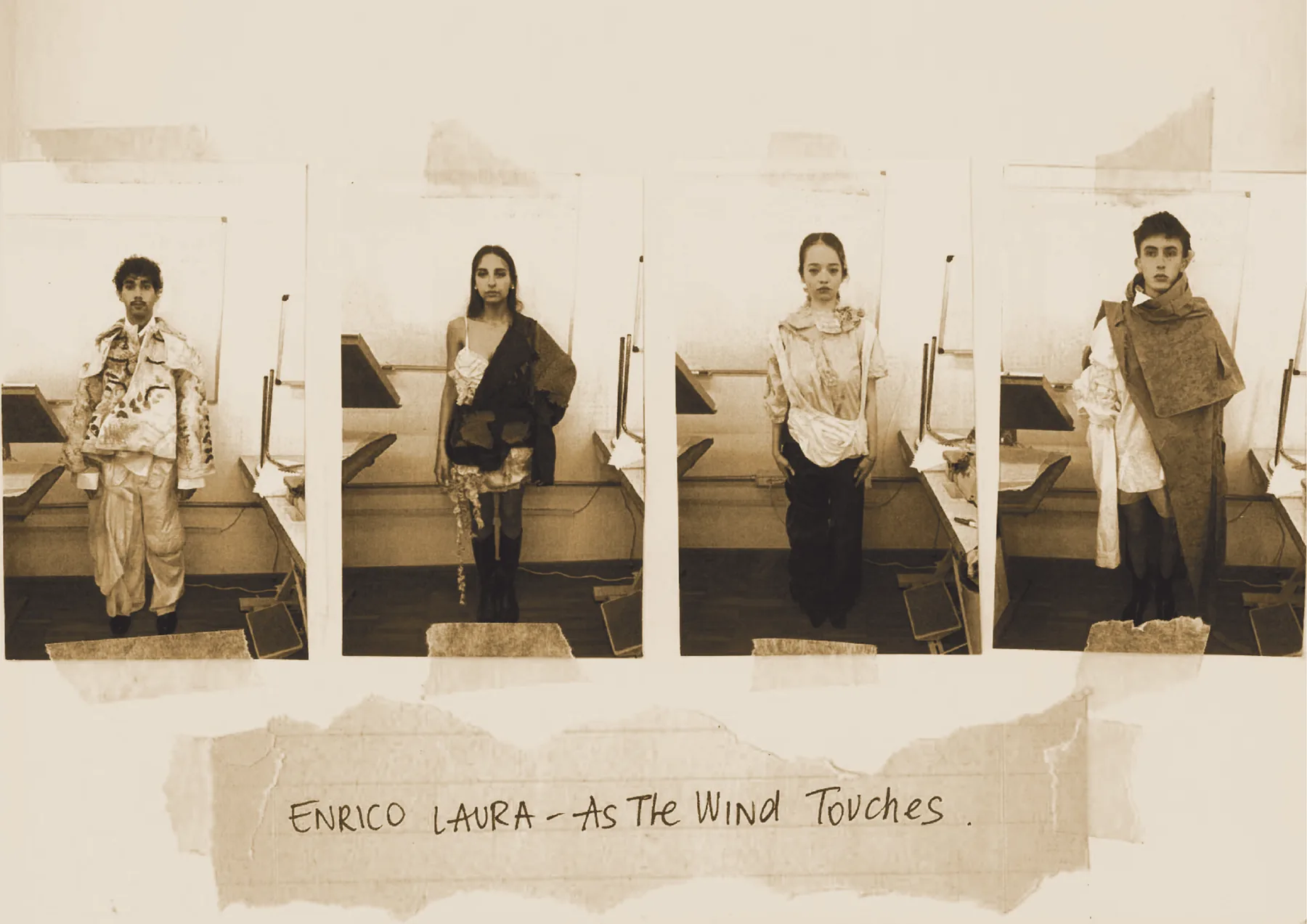
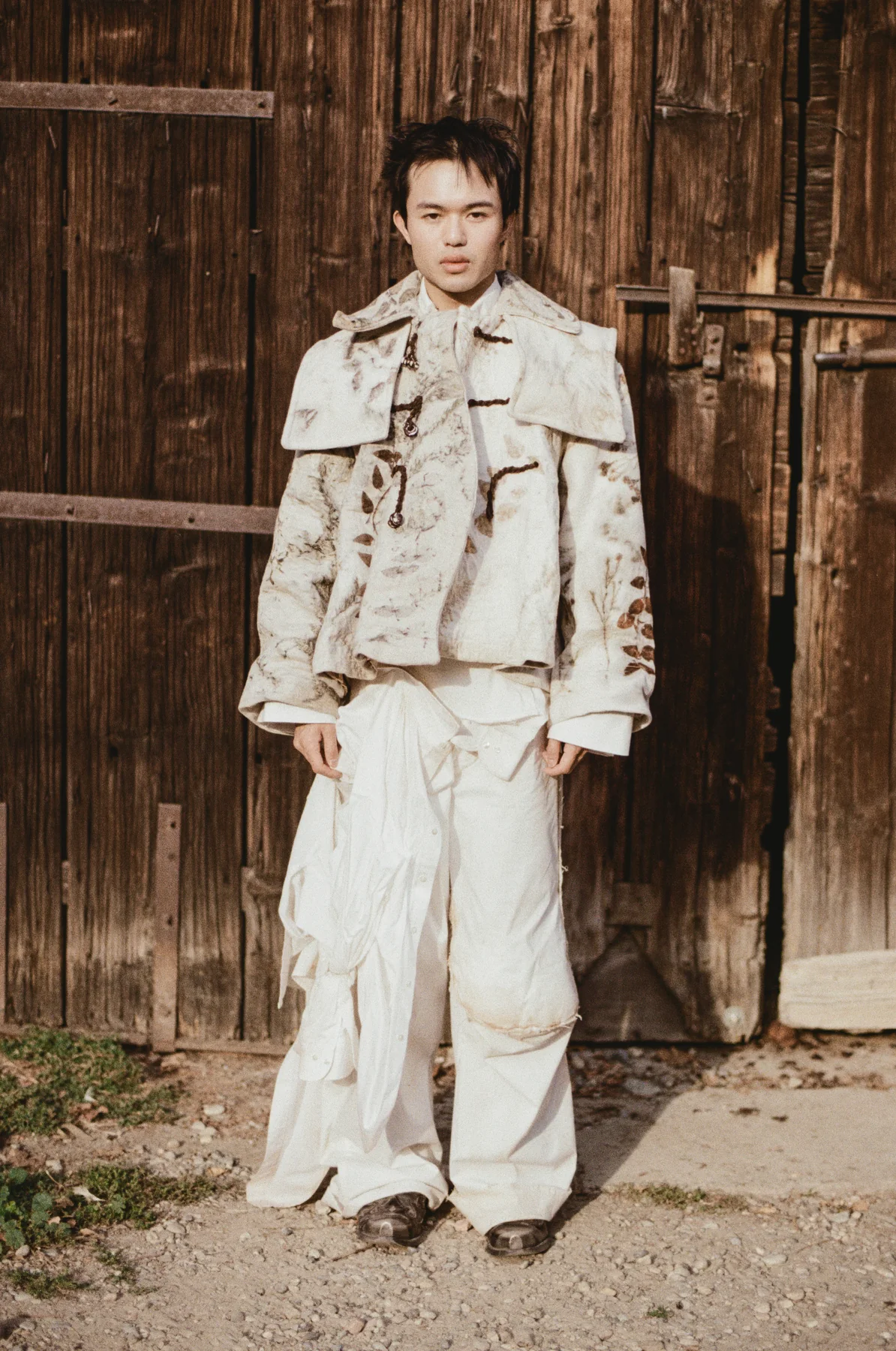
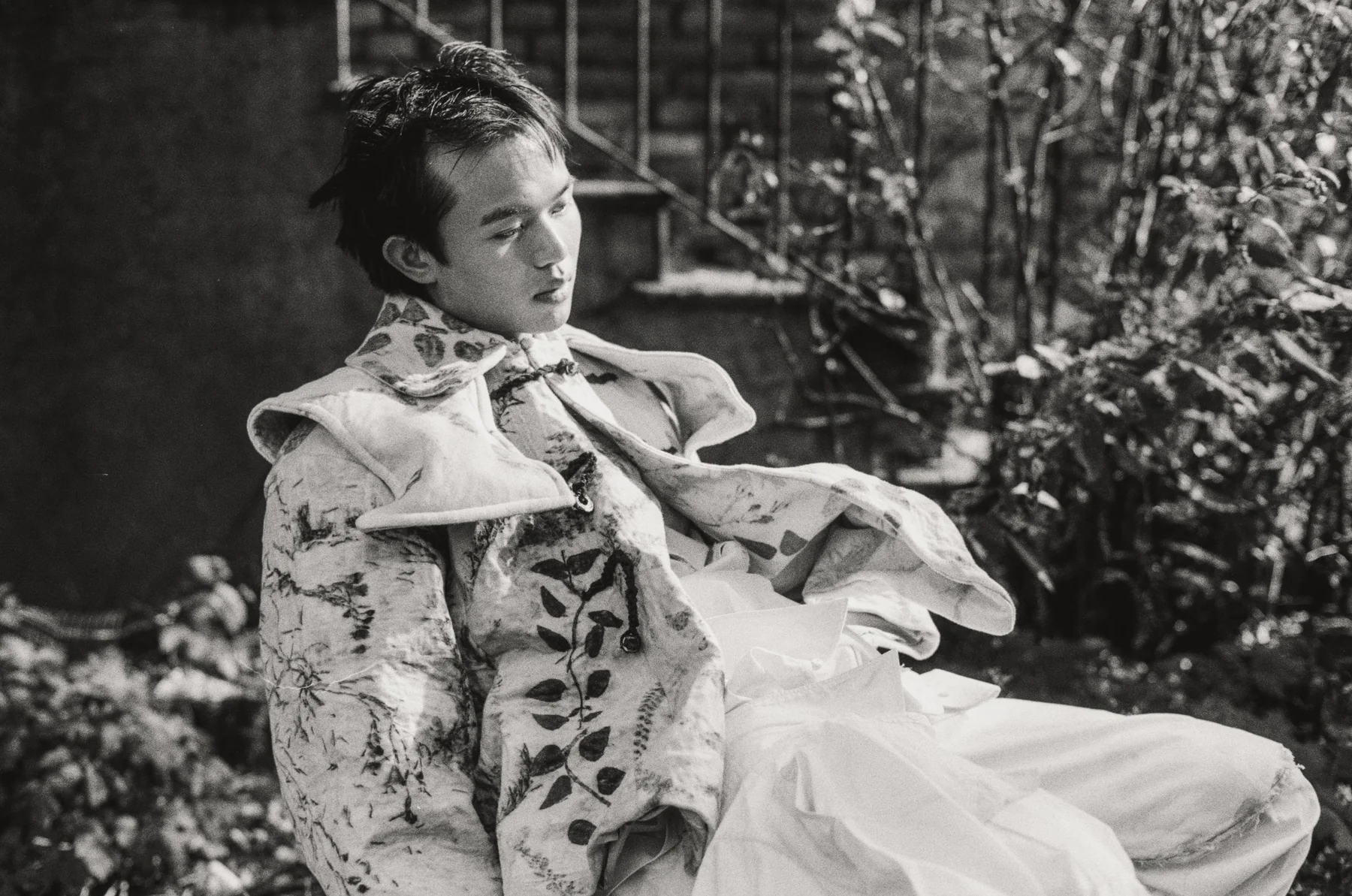
Look 01 is the Homeless. He wears a heavy winter montgomery coat against the cold, marked with leaf imprints that recall the places outdoors where he sleeps. His stained, worn trousers carry the hardship of his condition, and shirts draped around one leg are the belongings he has to keep with him at all times.
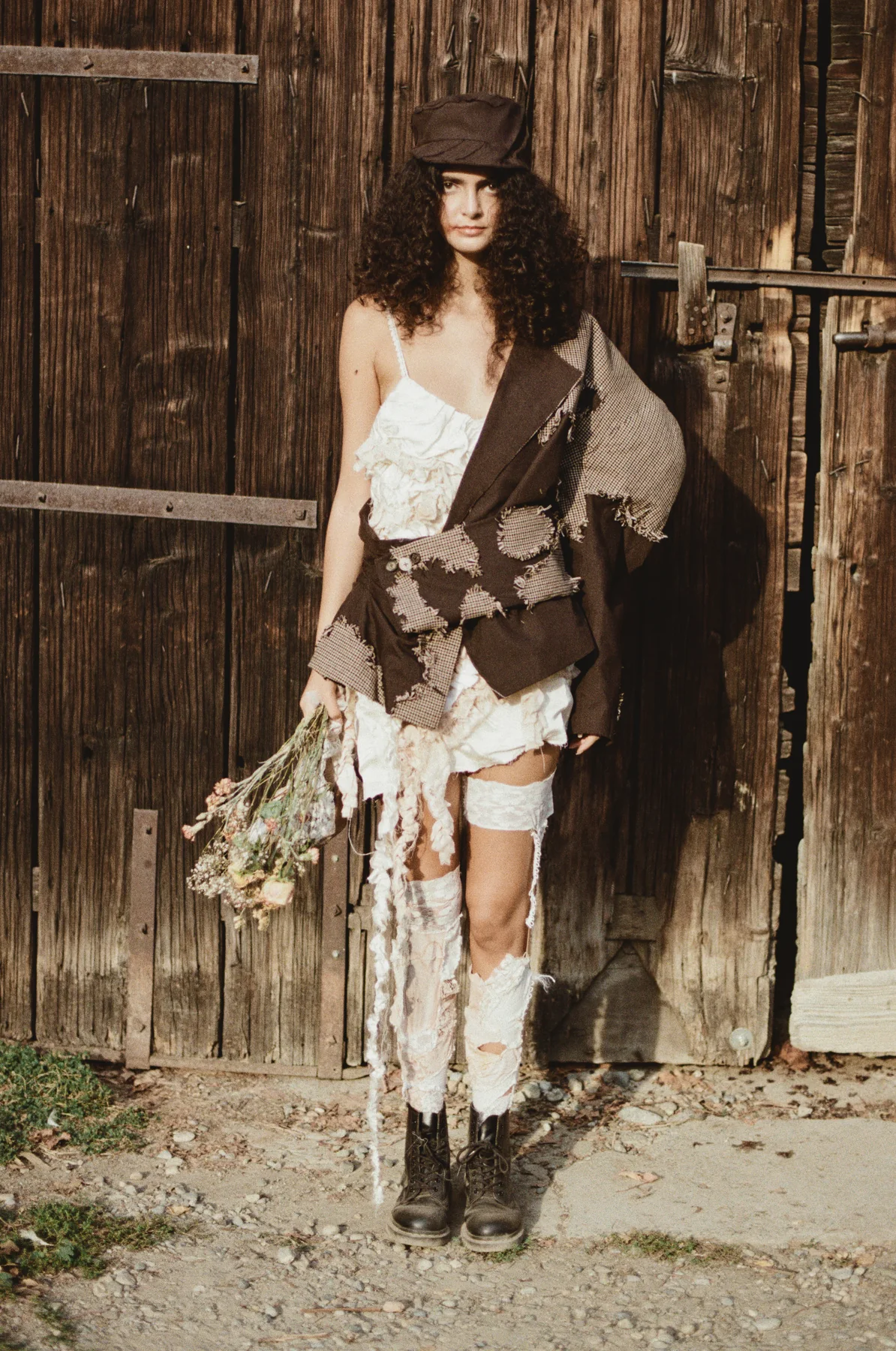
Look 02 is the Prostitute. She throws an oversized men’s blazer over her shoulders, imagined as belonging to one of her clients, to protect herself from the cold and from the gaze of passers-by, and wears it carelessly, in haste. Beneath it, a slip dress with a tattered hem and frayed details speaks of the fragility of a life lived on the margins.
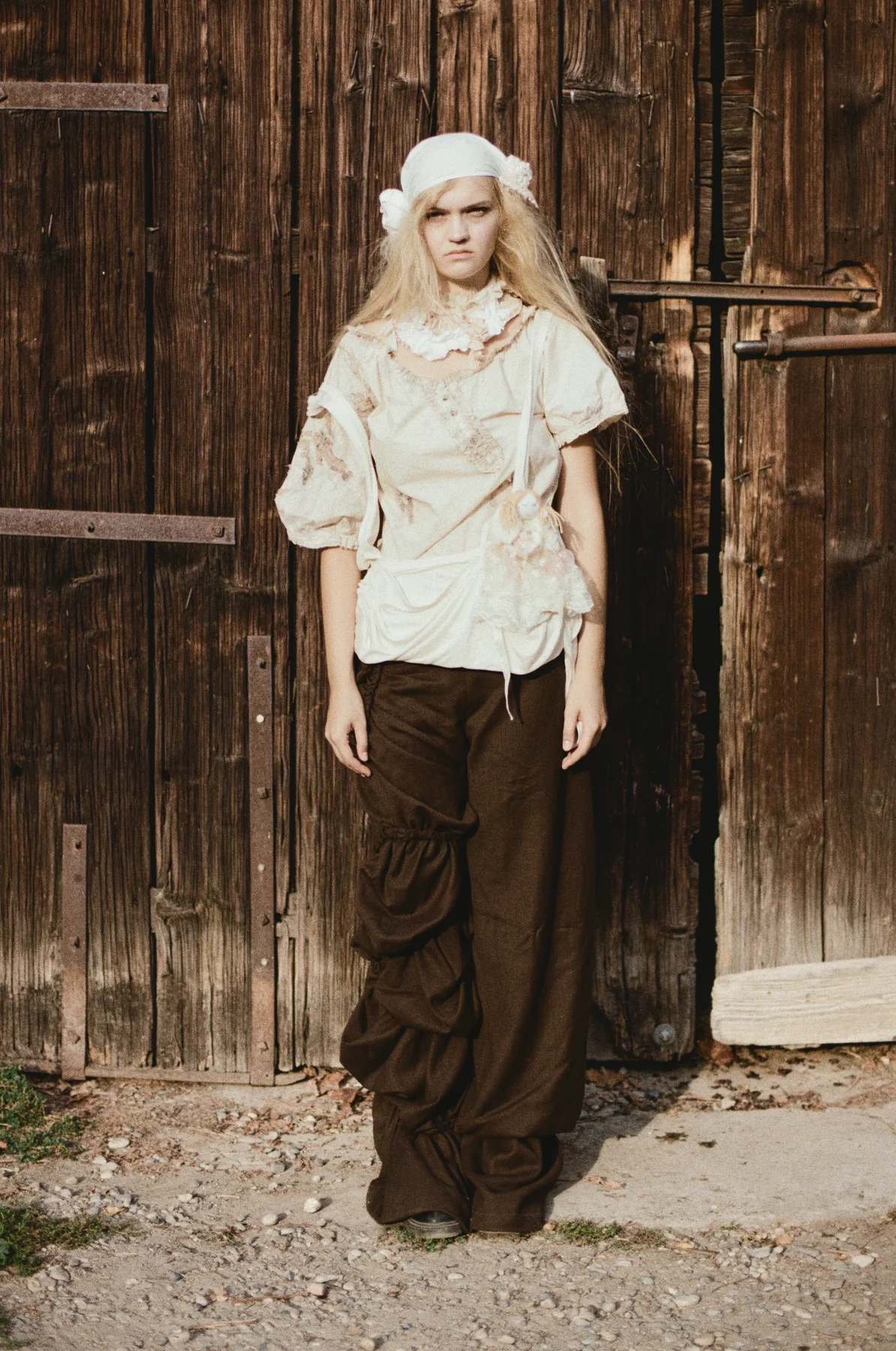
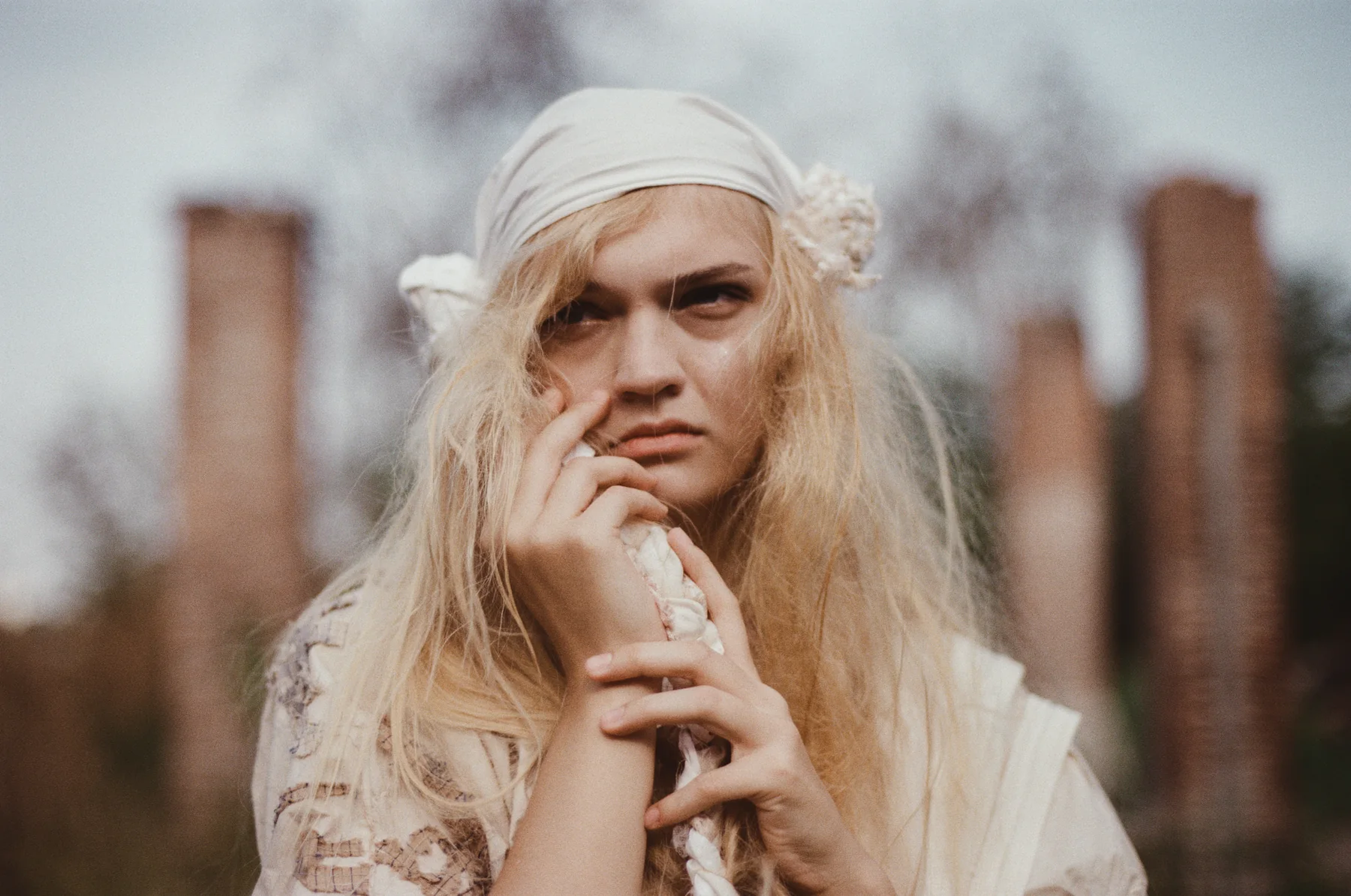
Look 03 is the Orphan, a young girl dressed in whatever she has managed to salvage. Her braided headpiece, blouse and Peter Pan collar recall childhood, while oversized adult garments tell a different story. A long tank top becomes a makeshift bag for her rag doll, and overlong trousers are draped around her legs: a child turning necessity into imagination.
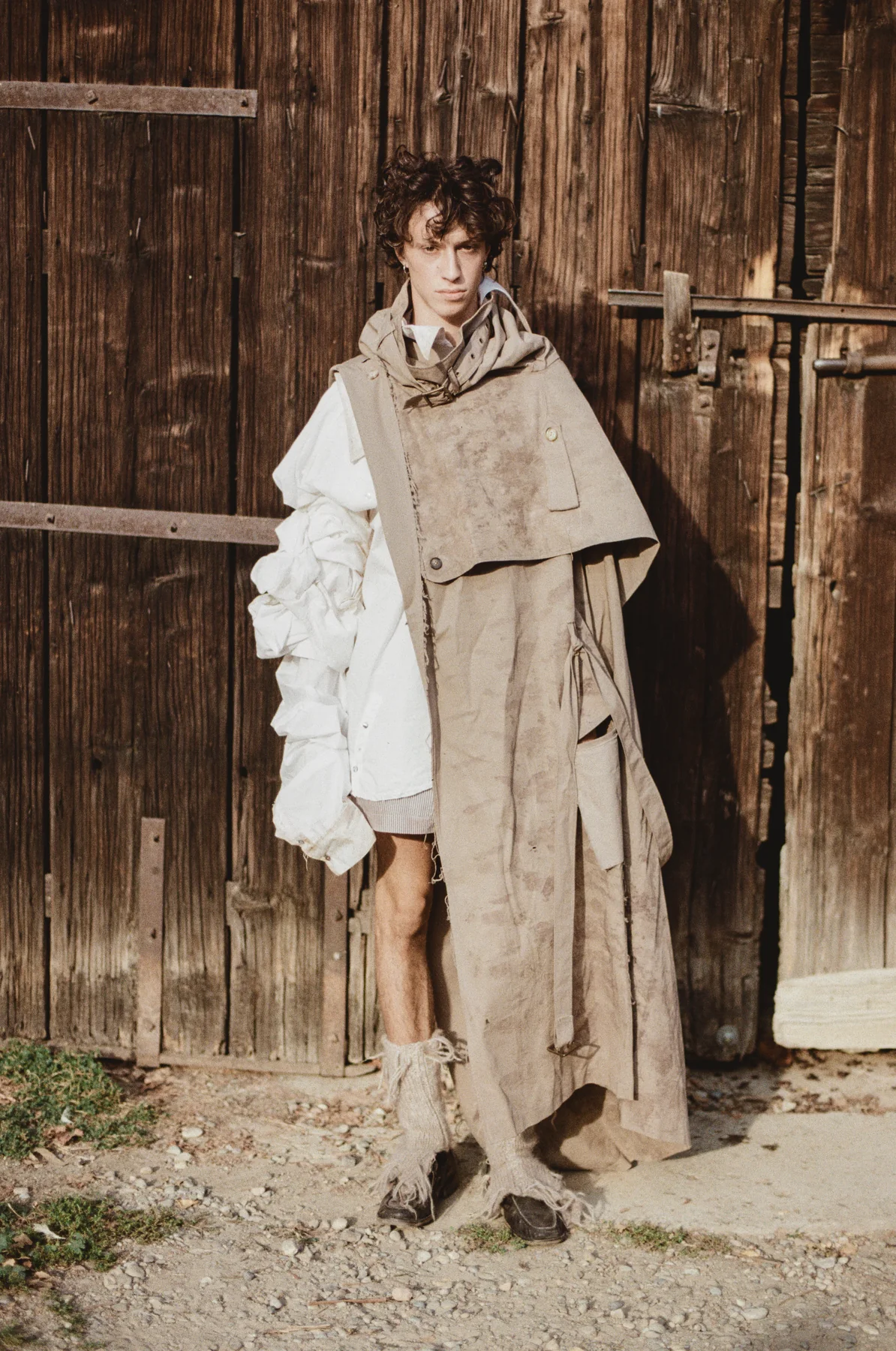
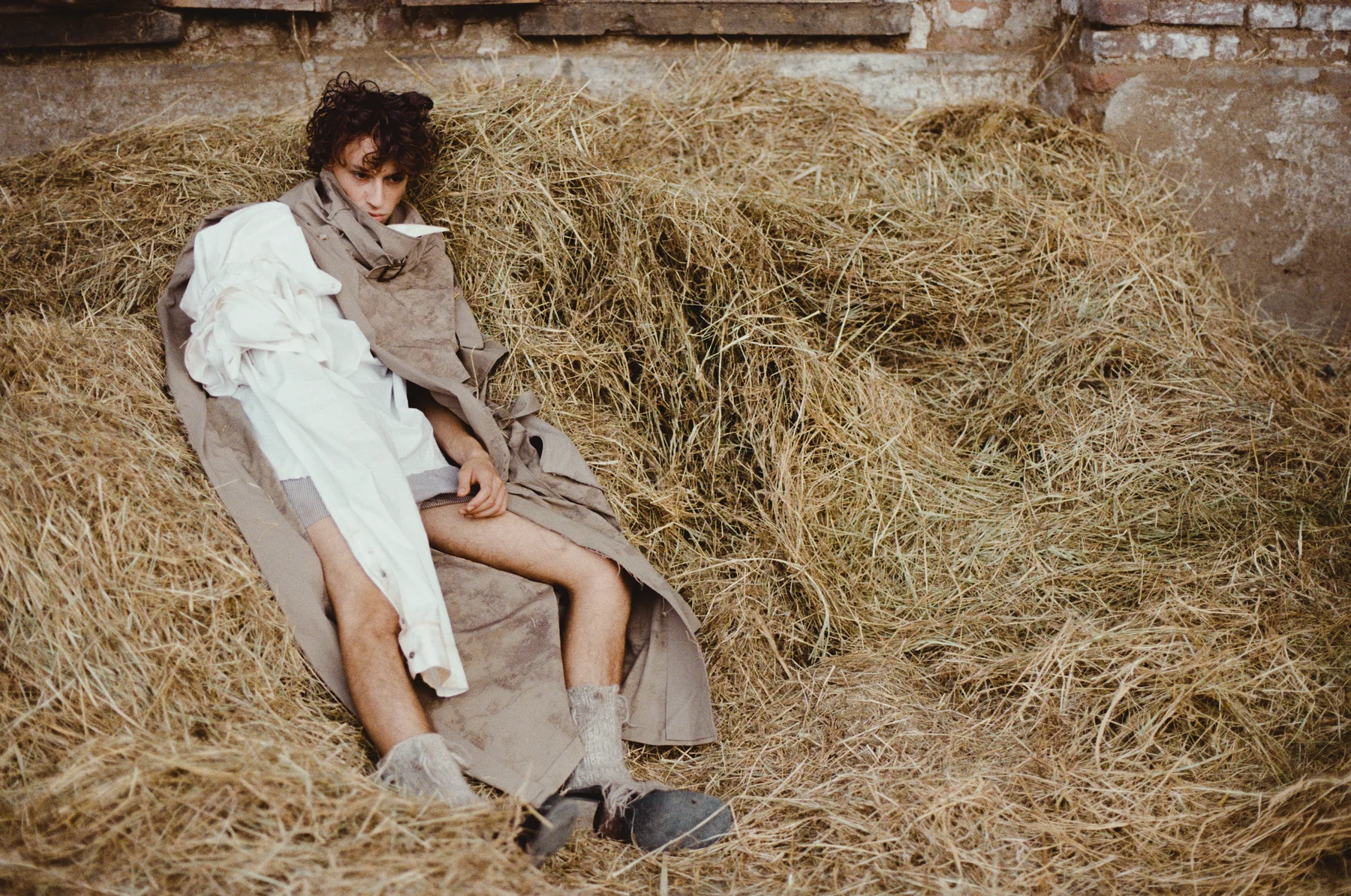
Look 04 is the Prisoner. His trenchcoat is the last shield against the cold and the judgement of the outside world, but he puts it on wrongly, in a hurry, slipping his head through a sleeve instead of the collar. The mistake leaves him almost naked, in his underwear. Beneath it, a shirt inspired by a straitjacket is distorted by a hump of draped shirts piled across one shoulder, a silhouette of both burden and vulnerability.
Leaves, tea and iron water
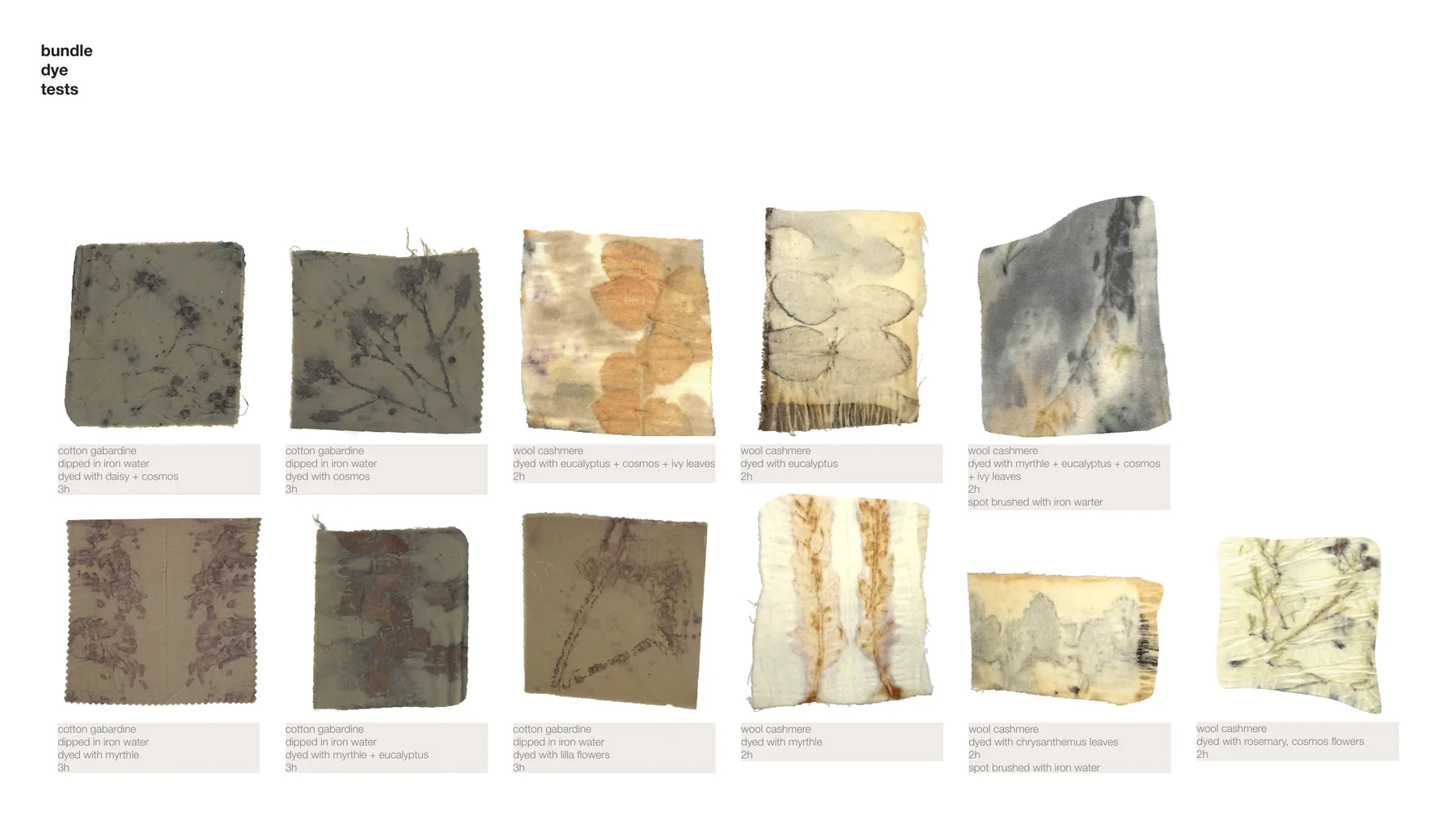
The surfaces were made by hand. The leaf prints come from bundle dyeing, a natural dyeing technique: leaves and flowers are laid on the fabric, rolled up and steamed, better still if the cloth has first been dipped in iron water. Her tests ran on cotton gabardine dipped in iron water and dyed for three hours with daisy, cosmos, myrtle, eucalyptus and lilac flowers, and on wool cashmere dyed for two hours with eucalyptus, cosmos, ivy, myrtle, chrysanthemum leaves and rosemary, some of it spot-brushed with iron water.
For the second and third outfits she worked in patchwork, from remnants and scraps of lace, jersey, old socks, lycra and cotton canvas, dyed with avocado and coffee. Another manipulation stitches small fragments of fabric onto canvas, leaving threads and raw edges exposed, then dip-dyes it in black tea for a worn, aged surface; the second outfit also uses wool felting. Layers of aluminium foil attached to the fabric make some garments mouldable, so that the wind seems to have stopped inside them. “Shape it however you want,” she wrote next to the fittings.
Fragile yet resilient, the clothes tell of instability and transformation, of the silent adaptation to the invisible forces that shape every existence.