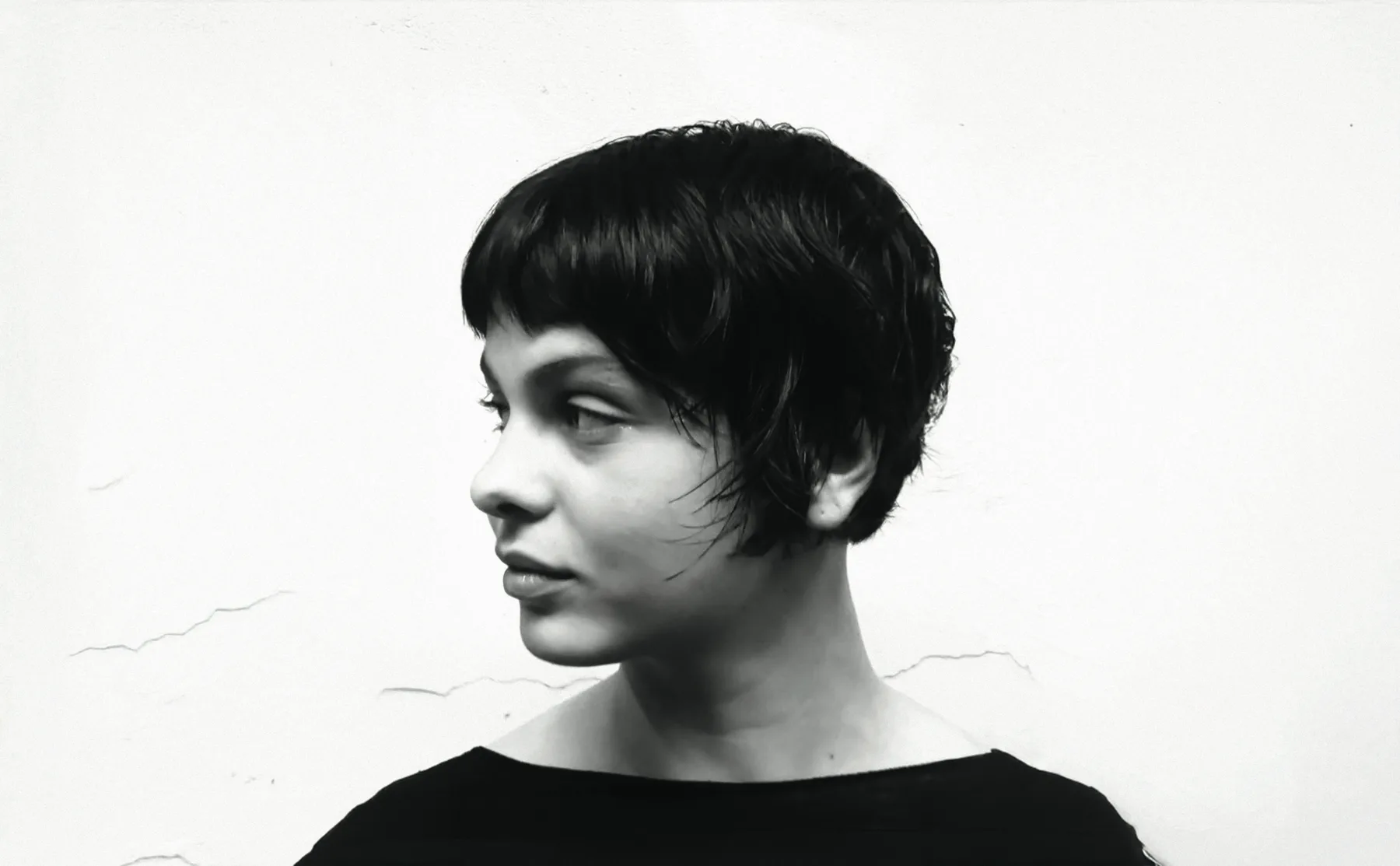
The designer from Ivrea who needs her hands on the cloth before she can imagine a garment, prints her fabrics with leaves from the garden she grew up in, and asks her clothes to carry a meaning.
The leaves printed on Laura Enrico’s graduation project were gathered from the trees in her garden and in the woods behind her house, the same places where she used to play as a child. She had chosen natural dyes because they can be made from waste, need no polluting substances and are within everyone’s reach. Using those leaves gave the work a second, more personal reason. It was a way, she said, to bring those places into her creative path and “to close a circle with the child I was”. The collection, ‘As the wind touches’, is the project into which she says she put all of herself.
Formation
Laura was born and raised in Ivrea, a small city in Piedmont, and her relationship with it has always been one of love and hate. She is deeply attached to the town and to the quiet of her childhood there, but growing up in such a small community also meant feeling other people’s eyes constantly on her, and for a long time that held back her wish to put herself forward.
Art was in the family. Her paternal grandmother painted, embroidered and knitted, and every visit ended with some small piece of handiwork prepared for her granddaughter; from her Laura learned patience, rigour and precision. At home her father worked in the opposite way, following inspiration and the flow of the moment. She traces her way of thinking to the balance between the two.
She attended a language high school, sure that sooner or later art would become her work. Fashion came during the pandemic, with a sewing machine she had in the house and tutorials found on YouTube: the first garments were made out of curiosity, to pass the time. Courses with a local seamstress followed, to learn the basics of tailoring, and then the move to Milan, where she has lived for three years and studied fashion design at NABA.
She speaks of that move as a detachment from the “old me”. The academy gave her technical and theoretical training, but what she values most is the people she met there, fellow students with passions for music, cinema and other arts, who widened her imagination. A close friend, asked for advice on a trivial matter of taste, answered with a question Laura has not forgotten.
“What is the beauty that moves something inside you?”
It made her think about how much her generation works to standards set by someone else, and how easily that hides what a person really likes.
Idea and pattern
Laura describes fashion as “a dialogue between concept and construction”, and in her work neither comes first. By her own account she is not an abstract thinker: she has to deal with the material to see a project in its final form. An idea becomes a drawing, but only the pattern and the prototype show her how far a piece can be pushed, and along the way the fabric or the cut may suggest a different direction. The first design is modified many times before it is finished.
The same method turns accidents into design. Playing with one of her own coats, draping it at random on a mannequin, she found a way of wearing it wrongly and then built a pattern around that discovery. The hardest part, she said, was translating such intuitions into precise tailoring, so that what looks out of place at first sight stays functional and wearable, and becomes part of the identity of the piece.
Clothes that protect
What holds her projects together is the conviction that a garment should say something, and should protect the body that wears it. In ‘ANOMALIE - specimen ∅’ the body is completely covered; in her graduate collection the characters are denied that privilege and left exposed. ‘Eclipse’, a fashion film made by four, with Desirè Cutini, Leslie Guerra and Chiara Belvederesi, asked her to put the clothes at the centre of a story without using words. Her portfolio holds all three.
The designers she looks to are chosen on similar ground. She admires Rei Kawakubo’s idea of beauty, Alexander McQueen’s storytelling, Martin Margiela’s deconstruction, Carol Christian Poell’s unconventional use of materials and Paul Harnden’s anachronistic approach, and she takes from them less a style than a principle: questioning what is considered conventional.
Today
Laura believes it is difficult to make anything completely new, now that access to images of shows and archives is almost unlimited, but she does not consider looking back a fault. Everyone is exposed to the same references and reworks them differently, and it is there, she thinks, that something personal can appear. She would like emerging designers to receive more attention than they do. For herself, she wants to gain as much experience as possible in the next few years, and to work with a brand rather than for one. Asked to describe her work in one sentence, she named what she hopes people will find in it: “something authentic and full of meaning”, in which they can recognise themselves.