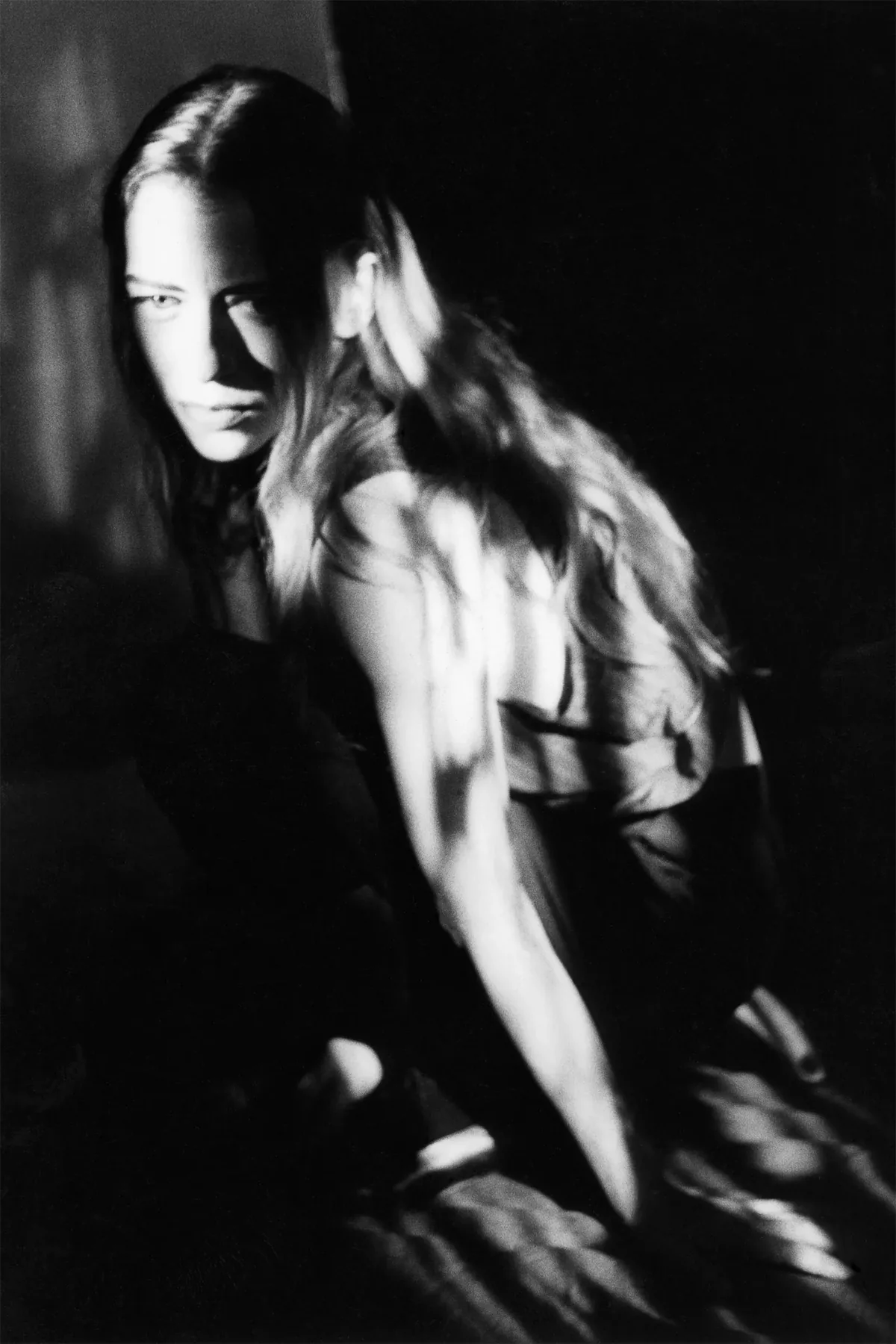
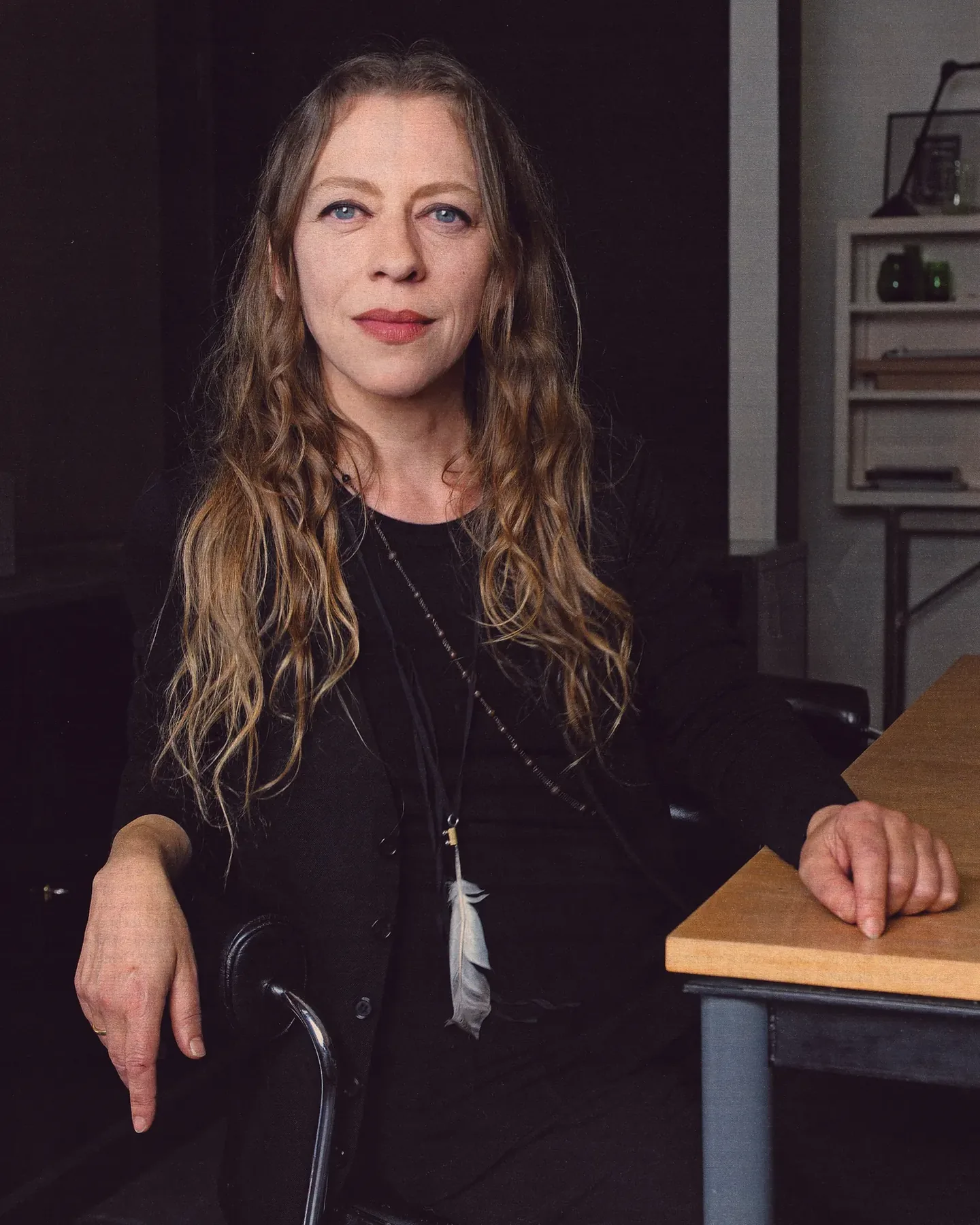
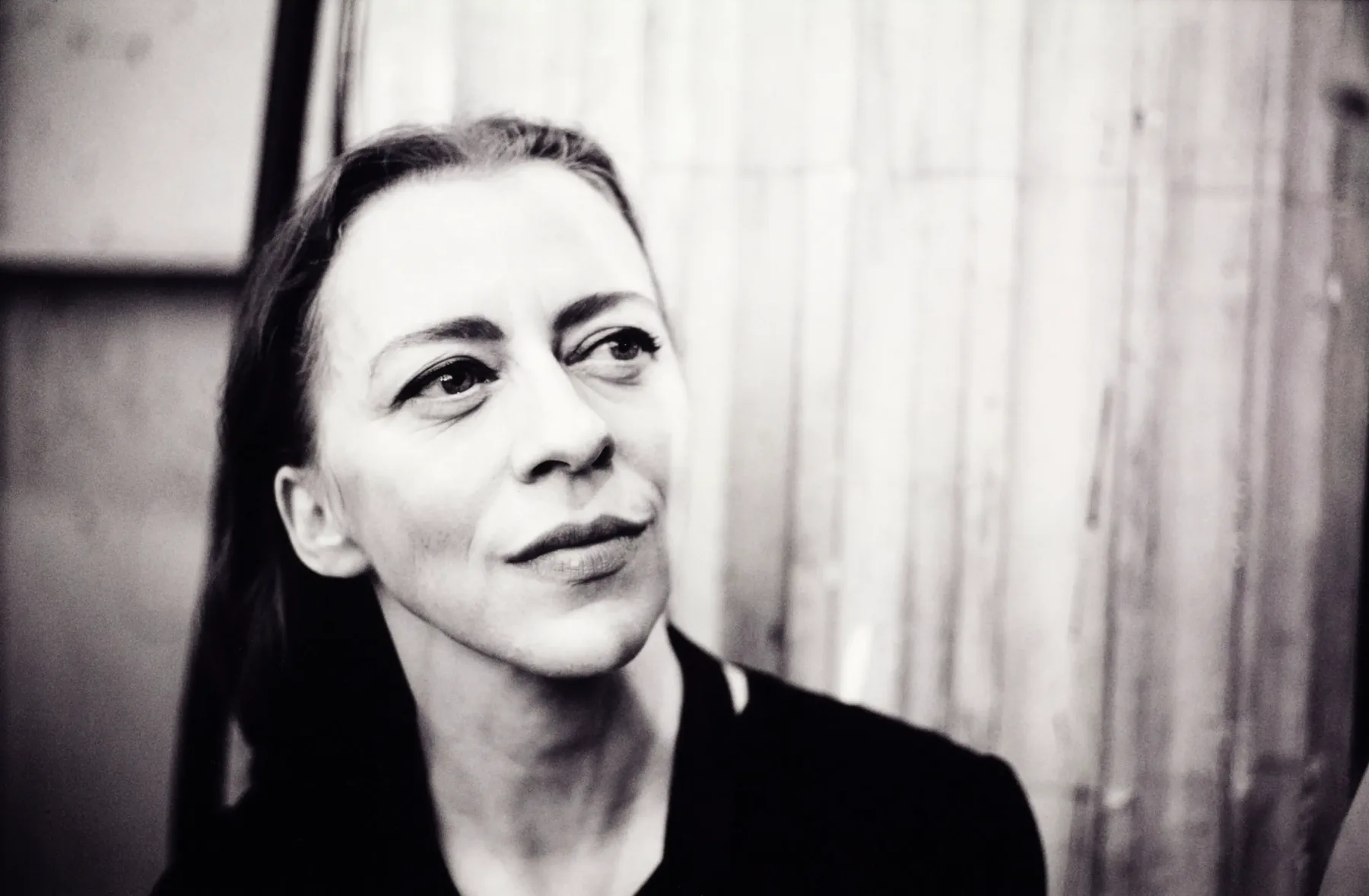
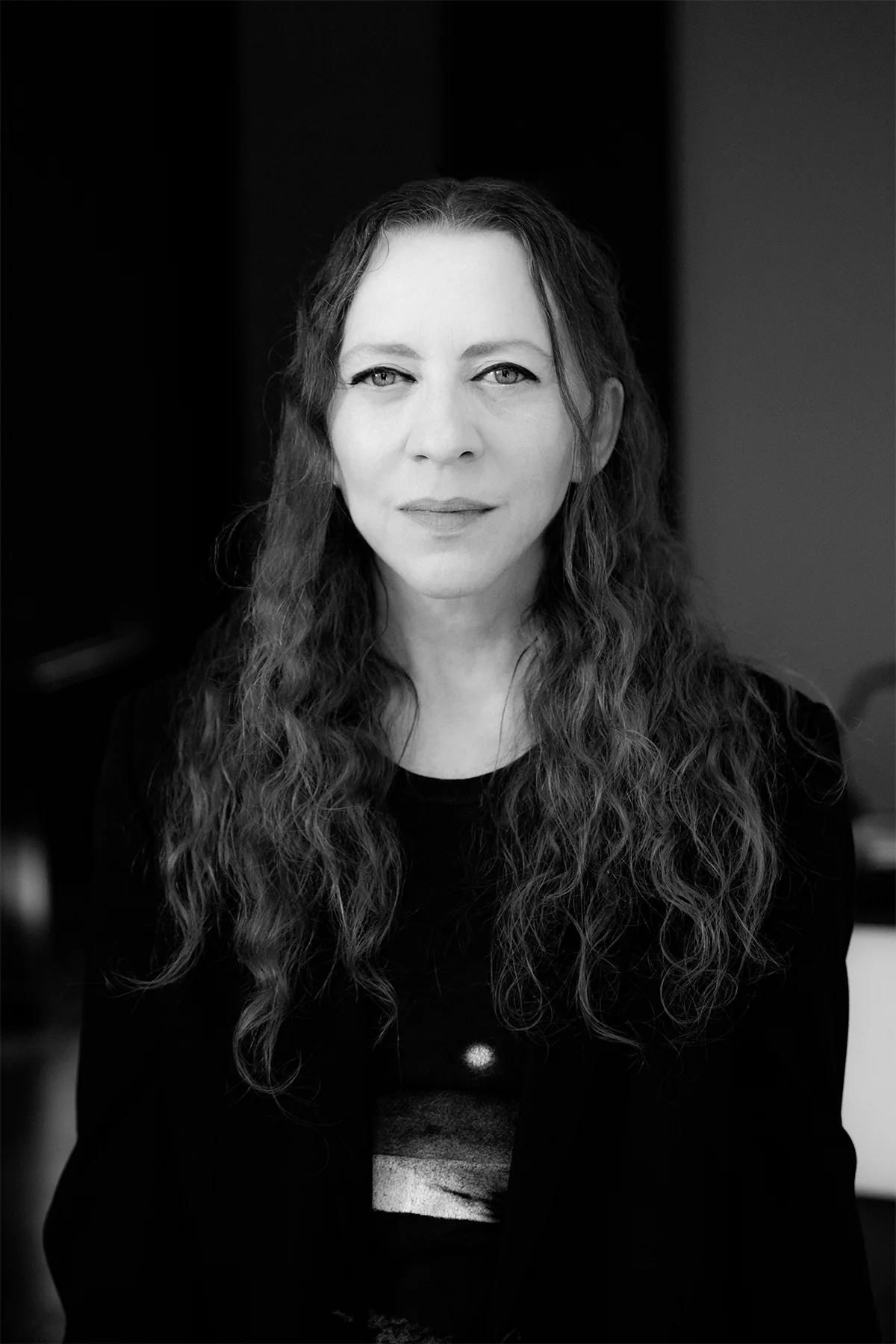
For twenty-eight years Ann Demeulemeester built a house in Antwerp on black and white, a few garments repeated season after season, and cloth cut to move with the body.
In November 2013 Ann Demeulemeester left the label she had founded with Patrick Robyn in 1985. She announced it in a handwritten letter. The brand, she wrote, was “an adult brand now with its own identity and legacy that is able to continue growing without me.” By then her vocabulary was fixed and recognisable: black and white, the shirt, the boot, the waistcoat, the long coat, feathers, and garments that hung from one shoulder. She had built it from Antwerp, at a distance from the large houses.
Formation
She was registered at birth as Ann Verhelst, in 1959, and grew up in Waregem. Her father and grandfather dried chicory for the coffee trade; there was no art in the family, but her father encouraged her drawing. She trained first in painting and studied portraiture in Bruges, where she began to notice how the clothes of a sitter shaped the person in the picture. At sixteen she met Patrick Robyn, who wanted to be an artist.
In 1978 she entered the fashion department of the Royal Academy of Fine Arts in Antwerp. Belgium had tailoring and children’s wear but no fashion identity, and the teaching followed Paris. One of her pattern-making teachers would not accept black and white in the same outfit and insisted on off-white, as Chanel had used it. Demeulemeester refused, with punk in London as her counter-example. She graduated in 1981, the year Rei Kawakubo first showed Comme des Garçons in Paris, and in 1982 she won the first Golden Spindle, the Belgian prize for young designers.
Antwerp, 1981–1991
Her years at the Academy produced the group later known as the Antwerp Six: Walter Van Beirendonck, Dries Van Noten, Dirk Van Saene, Dirk Bikkembergs, Marina Yee and Demeulemeester. They grew up with punk and new wave, and each answered that climate differently. The name was coined in London in the late 1980s to make Flemish names easier to place. Demeulemeester rejected the idea of a movement: “We weren’t doing things together.”
In 1985 she and Robyn founded the label and bought the only house Le Corbusier built in Belgium, which they restored and turned, with the buildings around it, into home and studio. Robyn put his own photography aside to share the creative direction, and he photographed the early collections for portfolios made with very little money. In 1986, when the others presented their work in London, she was pregnant and did not take part. Her first collection was for Autumn/Winter 1987–88. Her first runway show in Paris came in autumn 1991, for Spring/Summer 1992.
Paris, 1991–2013
In Paris the Belgians showed as individualists. Demeulemeester’s women wore dark, lean, practical clothes; the critic Cathy Horyn wrote that they looked “as if they had just finished a gig in Rotterdam.” Where Kawakubo had argued through cut that women were strong, Demeulemeester took it as a starting point. She began to work with leather in 1993. In 1996 she added menswear and showed it together with the women’s collection. She treated masculine and feminine as opposite and complementary parts of a single person.
She watched the 1990s turn towards large groups and global brands, and stayed outside them. To protect that independence she asked Anne Chapelle, a businesswoman she knew, to run the company in the mid-1990s; Chapelle organised it as a small multinational. In 1999 the house opened its own shop in Antwerp, on Leopold De Waelplaats, in a nineteenth-century building that had been a maritime college. In 2005 Chapelle acquired the majority of the company, and the design remained entirely Demeulemeester’s. By the mid-2000s her proportions and asymmetric cuts were visible in other designers’ collections; she said she did not follow their work.
“The same garments returned every season, changed through proportion, bias, layering and the position of a fastening.”
The language
The clothes were cut to move with the wearer. A jacket extended into a long line, a white shirt was left open or gathered with a ribbon, a sharply tailored piece was softened by a fall of silk. Prototypes were developed in black and white, so that the difference between structured wool, supple leather, lace and translucent fabric could be judged before any colour or print was added. Black was the base of the work and white its counterpart. The same garments returned every season, changed through proportion, bias, layering and the position of a fastening. Feathers appeared again and again as a sign of fragility held inside something hard.
She spoke of the clothes as living things. “I want to fill them with soul,” she said. Her references were literary and musical as much as visual: Arthur Rimbaud and Hermann Hesse, Jackson Pollock and René Magritte, Patti Smith and PJ Harvey. Text, photographs and hand-drawn marks entered particular garments without turning a season into a tribute.
Collaborations
Some of these references became collaborators. After seeing photographs by Jim Dine in a gallery, she wrote to him the same day; a few days later he was in her studio. For Spring/Summer 2000 his photographs of birds of prey were printed in silvery grey on asymmetric dresses worn with ribbons. Patti Smith, whose recording of a poem by Allen Ginsberg opened Spring/Summer 1998 ‘Corps Humain’, took part in the Autumn/Winter 2006–07 menswear presentation.
After the house
Sébastien Meunier continued the collections after her departure. In 2020 the house was acquired by the Antonioli group of Claudio Antonioli, and its new direction began with Autumn/Winter 2021–22. Demeulemeester moved her work to objects and domestic space, again with Robyn. In October 2014 Rizzoli published a monograph of three decades of her work, in images, drawings, texts and references. From 2019 she designed porcelain, cutlery and glass for the Belgian brand Serax, including the porcelain lines Dé and Ra, followed by lighting and, in 2022, furniture. In 2023 she contributed to “A”, the house’s fragrance, without returning to its seasonal collections.
Timeline
Click a date for details
Formation 1978–1985
- 1981
- Graduates from the Academy.
- 1982
- Wins the first Golden Spindle.
Ann Demeulemeester 1985–2013
- 1987
- First collection, Autumn/Winter 1987–88.
- 1991
- First runway show in Paris, Spring/Summer 1992.
- 1993
- Leather enters the collections.
- 1996
- Menswear, shown with the women’s collection.
- 1997
- Spring/Summer 1998 ‘Corps Humain’.
- 1999
- Flagship store on Leopold De Waelplaats, Antwerp.
- 2000
- Spring/Summer 2000 with Jim Dine’s photographs of birds of prey.
- 2005
- Anne Chapelle becomes majority owner.
- 2006
- Patti Smith in the Autumn/Winter 2006–07 menswear presentation.
- 2013
- Leaves the label in November, with a handwritten letter.
After the house 2014–today
- 2014
- Monograph published by Rizzoli.
- 2019
- Porcelain, cutlery and glass for Serax.
- 2020
- The house is acquired by Claudio Antonioli.
- 2022
- A furniture line.
- 2023
- Contributes to “A”, the house’s fragrance.